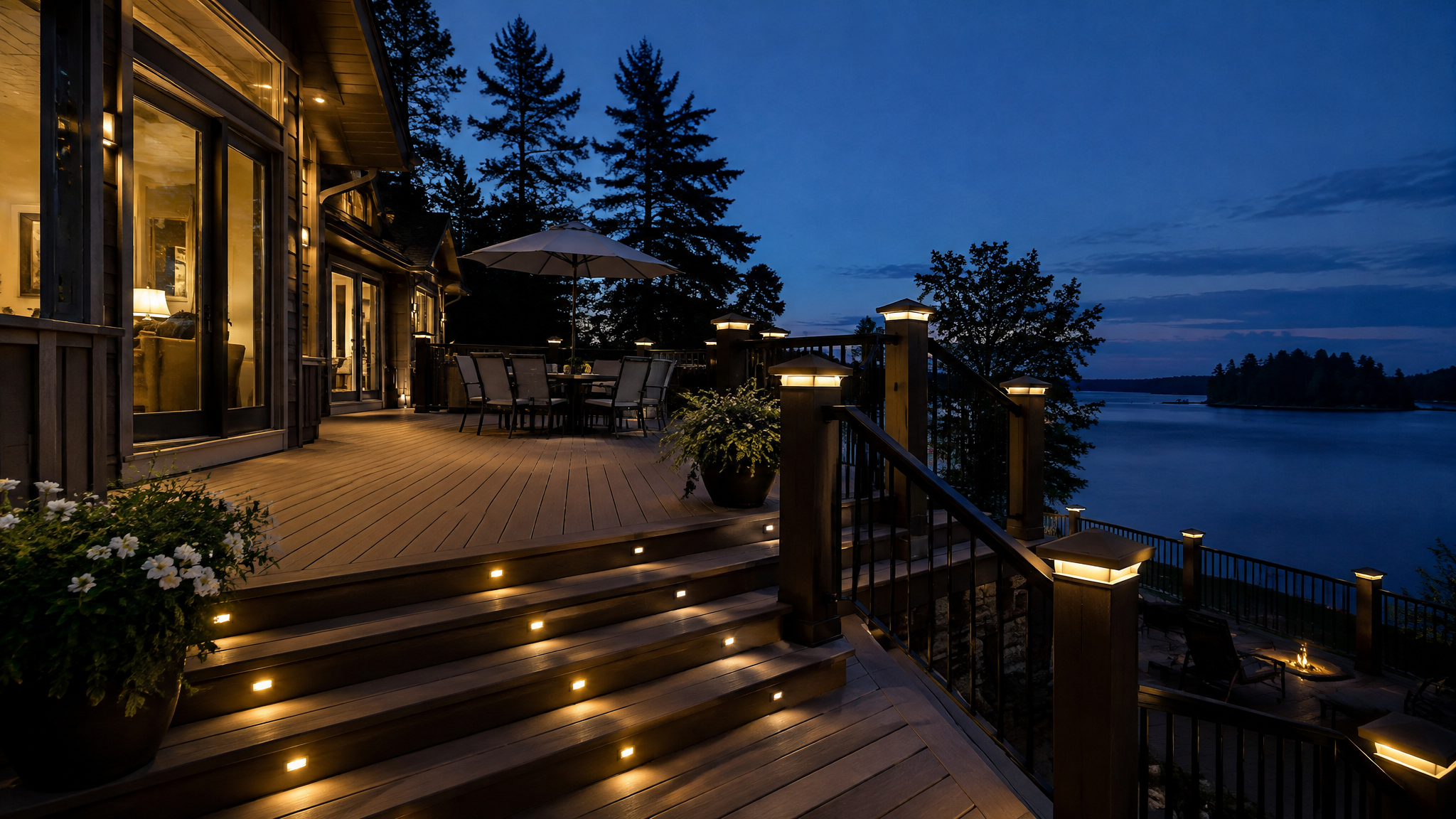
If you own property in Muskoka, there is a good chance your lot sits on Canadian Shield granite. This billion-year-old rock formation underlies most of the district, and on many properties it is right at the surface: exposed, hard, and impossible to dig through. That creates a unique challenge for deck building, because conventional concrete footings simply do not work when there is nowhere to dig.
The good news is that granite makes an outstanding foundation material. It does not shift, settle, heave, or erode. The challenge is connecting your deck to it securely. Here is how we do it.
Why Standard Footings Do Not Work on Rock
In most of southern Ontario, deck footings are poured concrete sonotubes. You dig a hole below the frost line (typically 48 inches deep in this part of Ontario), insert a cardboard tube form, fill it with concrete, and set a post bracket on top. The depth below the frost line prevents frost heave from pushing the footing upward during winter.
On the Canadian Shield, you often hit solid rock within the first few inches of digging, or the rock is right at the surface with no soil at all. You cannot dig through granite with a post hole digger. And even if you brought in a rock drill, drilling a 48-inch-deep, 12-inch-diameter hole in granite for every footing would be prohibitively expensive and unnecessary.
The reason you need to go below the frost line in soil is that wet soil expands when it freezes, pushing the footing upward (frost heave). Rock does not behave this way. Solid granite does not absorb significant moisture and does not expand when it freezes. That means you do not need to go below the frost line when you are anchoring directly to rock. You just need a secure connection.
Method 1: Rock Pinning (Epoxy Anchors)
Rock pinning is the most common footing method in Muskoka and the go-to technique for exposed Canadian Shield granite. Here is how it works:
- Mark the footing locations. Each footing point is marked according to the approved deck plans.
- Drill the holes. A diamond-tipped core drill bores holes into the granite. Typical hole diameter is 3/4 inch to 1 inch, and depth is 6 to 12 inches depending on the rod size and load requirements.
- Clean the holes. Drill dust and debris are blown out of the holes with compressed air. A clean hole is critical for epoxy adhesion.
- Insert the rod and epoxy. Structural epoxy (typically a two-part cartridge system) is injected into the hole, and a threaded steel rod (5/8 inch or 3/4 inch) is inserted and turned slowly to distribute the epoxy evenly.
- Cure. The epoxy cures for 24 to 48 hours, depending on temperature and product specifications. During this time, no load is placed on the anchors.
- Attach brackets. Adjustable post brackets are threaded onto the protruding rod and leveled. These brackets accept the deck posts and allow fine height adjustment.
The result is a footing that is chemically bonded to solid bedrock. Pullout strength in sound granite with properly installed epoxy anchors exceeds what is needed for residential deck loads by a wide margin. Rock-pinned footings do not shift, do not heave, and will outlast the deck itself.
Method 2: Helical Piles
Helical piles (also called screw piles) are steel shafts with helical flights welded to the lower section. They are driven into the ground by a hydraulic motor mounted on a mini excavator or skid steer. As the pile rotates, the helical flights pull it downward into the soil until it reaches bearing capacity.
Helical piles are used in Muskoka when:
- The rock is too deep to reach practically but the soil above it is not reliable for sonotubes (common on properties with a mix of soil and rock)
- The rock is fractured or layered and not suitable for epoxy anchoring
- The site has soft, wet, or organic soil that would not support concrete footings
- Access is tight and a concrete truck cannot reach the site
Helical piles install quickly (30 to 60 minutes per pile), produce no soil spoils, and are immediately ready to bear load. They are more expensive than sonotubes but competitive with rock pinning, typically $300 to $600 per pile installed.
Method 3: Surface-Mount Brackets
For smaller structures and situations where the rock surface is flat and accessible, surface-mount brackets can be bolted directly to the granite using expansion anchors or wedge bolts. This method is simpler and cheaper than rock pinning, but it has limitations. Surface mounts rely on the bolt's connection to the rock surface, which is shallower than a rock pin. They work well for lightweight structures like small platforms, privacy screens, and railings, but are generally not sufficient for primary deck footings on larger structures.
Mixed Conditions: Combining Methods
Many Muskoka properties have mixed ground conditions. One corner of the deck site might have exposed granite ideal for rock pinning, while the other corner has 4 feet of soil over rock that calls for helical piles or sonotubes. It is completely normal and standard practice to use different footing methods on the same deck, matched to the conditions at each footing point.
Lateral Bracing on Rock Foundations
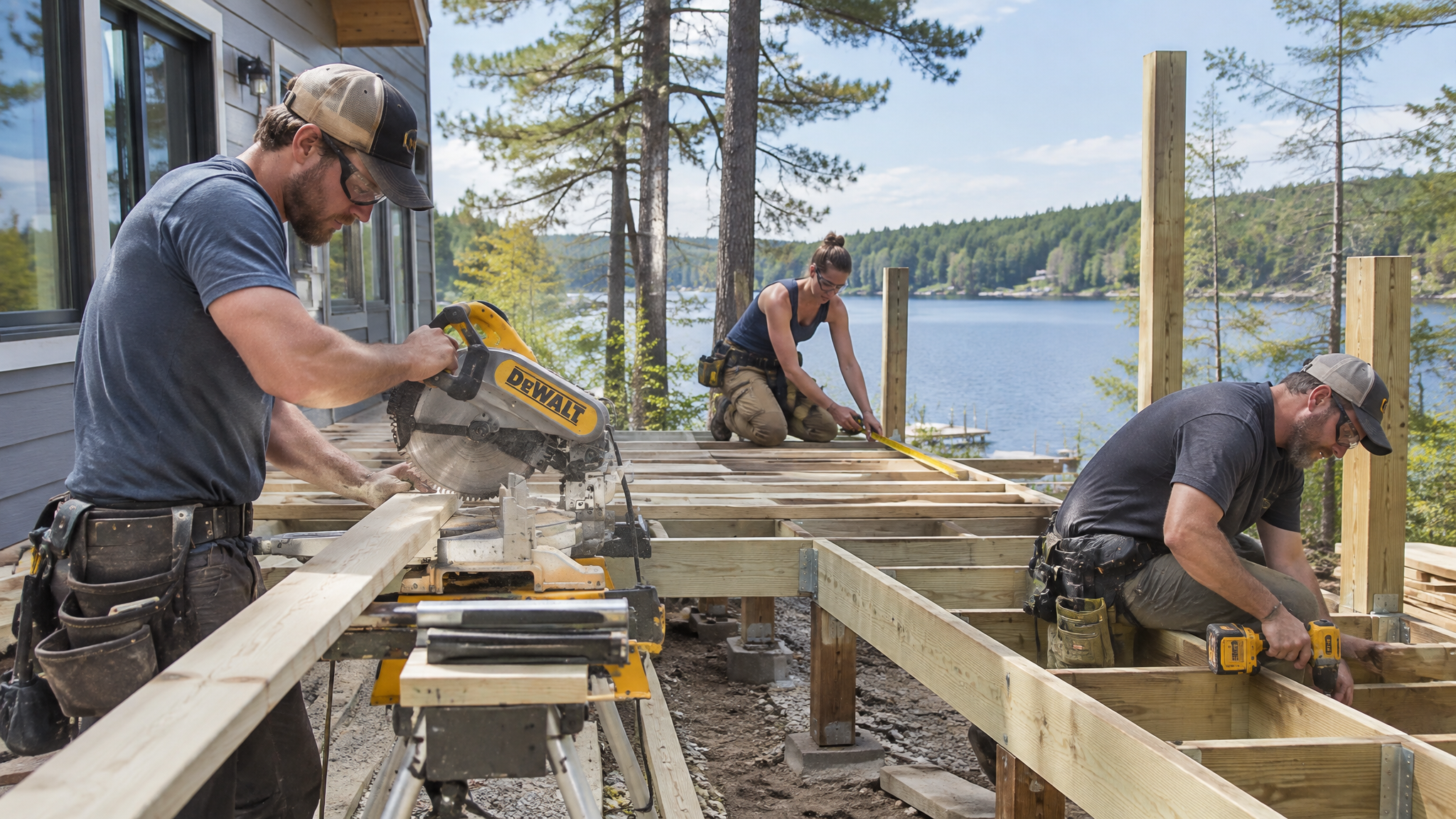
One important consideration when building on rock: deck posts on rock-pinned footings are not embedded in the ground. They sit on top of the rock in brackets. This means they do not get the lateral stability that a soil-embedded post naturally has. To compensate, decks on rock foundations need explicit lateral bracing, typically diagonal knee braces between the posts and beams, blocking between joists, and proper connection hardware at every joint.
We engineer the bracing into every rock-foundation deck we build. It is not optional; it is what keeps the structure rigid and safe over time.
Getting It Right
Building on the Canadian Shield is not something that every contractor is equipped to handle. It requires the right tools (core drills, hydraulic pile drivers), the right materials (structural epoxy, steel rod, helical piles), and the experience to know which method fits which conditions. We have that equipment and that experience. If your property sits on rock, get in touch and we will assess your site.